
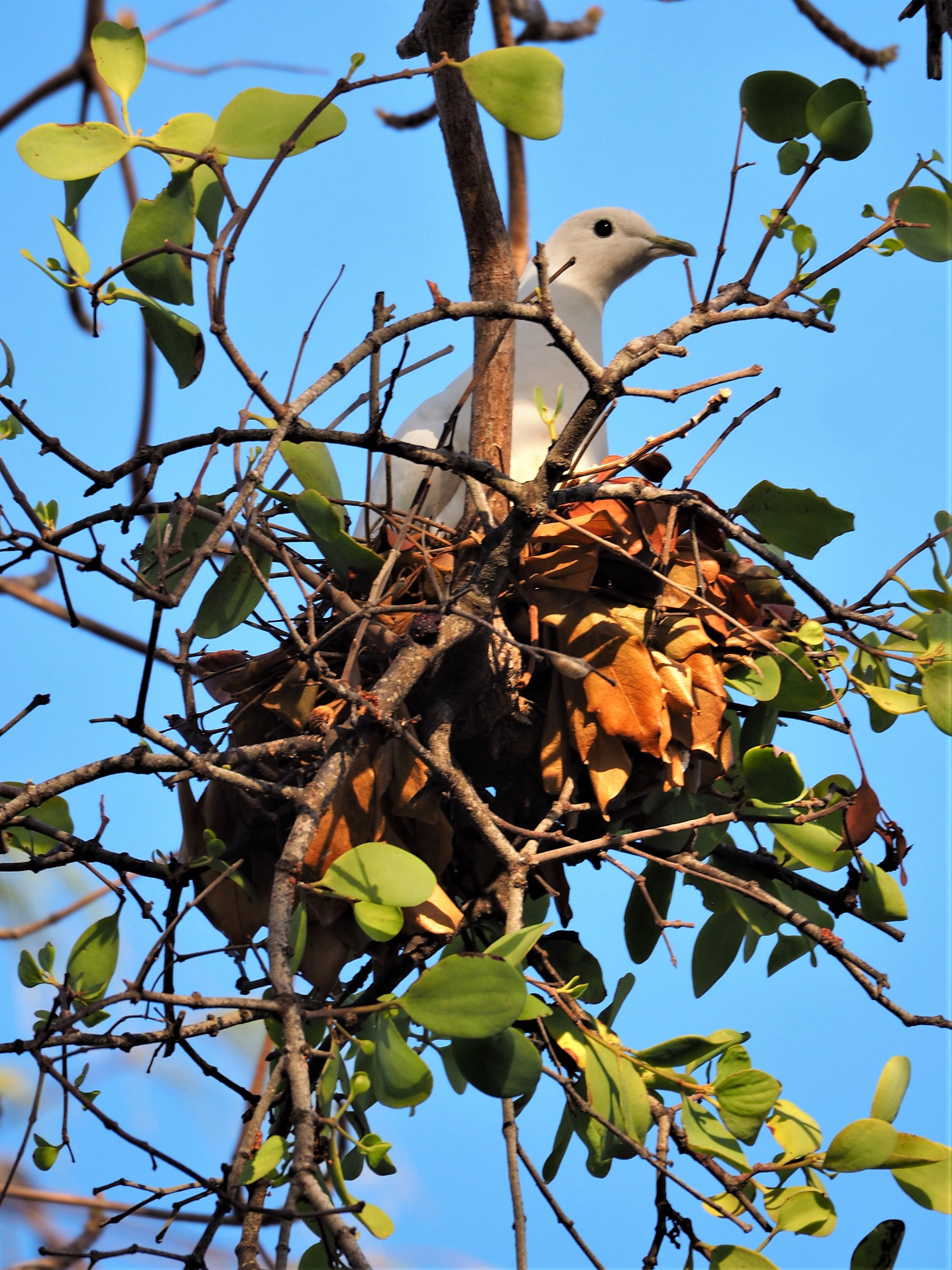
Pied Imperial Pigeon counts
LIPS volunteers have monitored the iconic PIP migration and nesting at Low Isles since 1994 — one of Queensland's longest-running bird monitoring programs.
Latest: 2024–2025 season data now available
Full season figures broken down by site for the first time. Coordinated by Dusty Howman.
Between September and March, an estimated 20,000–25,000 pied imperial pigeons live and breed at Low Isles — one of the most spectacular wildlife events on the Great Barrier Reef.
LIPS volunteers undertook the first count for the 2024–25 season at the end of September 2024, recording nearly 9,000 birds — a marked increase from the sad 151 counted just a month after Cyclone Jasper in February 2024, and a contrast to the 18,000 typically counted during the busiest months of 2022–23.
The seasonal migration and nesting of PIPs on Woody Island has been the subject of a long-term study with which LIPS has been involved since 1994. Data is submitted to the Queensland Parks and Wildlife Service WildNet database for scientific analysis.
This season also saw the commencement of shorebird and fixed-route bird surveys for the first time, with seven different species found in the trees of Low Island. This data is being uploaded to the Australia-wide BirdLife database.
"…the historic success of PIP populations in Queensland stems from their selection of breeding sites on remote islands that are largely free of relevant predators and anthropogenic activity… Future conservation of extant PIP abundance will depend crucially on protection of island breeding sites."— Hazel & Venables (2017), Wildlife Research, 44(1) 40–47
How the count works
Three counting stations
Three pairs of volunteers sit at stations covering birds returning from the north rainforests, the western coast, and the southern range.
Dusk counting
Counting occurs between 4pm and last light as birds return from mainland rainforest feeding grounds to their nests on Woody Island.
Pair estimation
Once nesting, each bird counted represents half a pair — the returning bird is relieving its mate on the nest.
Data to WildNet
Totals are submitted to QPWS's WildNet database, building a longitudinal dataset of real scientific value for climate and conservation research.
PIPs at Low Isles


About the Pied Imperial Pigeon
The Pied Imperial Pigeon (Ducula bicolor) is a large, distinctive black and white pigeon — mostly white with black outer wings, tail tip and tail underside bars. Also known as the Torresian Imperial Pigeon, Torres Strait Pigeon or Nutmeg Pigeon.
A summer migrant to northern Australia, it nests colonially on many Great Barrier Reef islands. Its major breeding colonies occur on offshore islands — most notably Low Isles off Port Douglas and North Brook off Cardwell. Food is obtained from mainland rainforest, with birds flying to and from the coast each day.
Nest density correlates with vegetation density and annual fruit production, particularly species of Lauraceae. Declining numbers have historically been linked to large-scale shooting and clearing of mainland rainforest feeding grounds.
Pied Imperial Pigeons lay up to three clutches of eggs per season. Both male and female incubate on alternate days and both brood and feed the chicks.
🌿 Fun fact: What do PIPs eat?
From December 1994 to April 1995, researchers analysed PIP droppings at Low Isles to determine diet. A total of 68 plant species were recorded over four months.
The most popular items included:
- Yarrabah satinash (Syzygium angophoroides)
- Ribbonwood / pink poplar (Euroschinus falcata)
- Damson (Terminalia seriocarpa)
- Little gooseberry tree (Buchanania arborescens)
- Hairy Mary lawyer cane (Calamus australis)
Source: Tropical Topics No.28, June 1995, QLD Dept of Environment and Heritage
Research & citations
Hazel, J. & Venables, B.L. (2017). Can island specialists succeed as urban pioneers? Pied imperial-pigeons provide a case study. Wildlife Research, 44(1), 40–47.
Confirms that the PIP counts at Low Isles are part of an important long-term monitoring program for Queensland.
Brothers, N. & Bone, C. (2012). Torresian Imperial Pigeon Ducula spilorrhoa monitoring, population trends and species suitability as an indicator of environmental changes. Corella, 36(3), 69–75.
Read full paper →Breeding, Feeding and Status of the Torres Strait Pigeon at Low Isles, North-eastern Queensland, January 1975. Emu, 75(4), 189–198.
Early baseline study on nesting density and diet at Low Isles.
Transport supporters
The support given by Quicksilver Cruises & Wavedancer Low Isles in transporting volunteer counters has been integral to the long-term project. During COVID, Calypso and Sailaway also kindly transported our volunteers — without these operators, the longitudinal dataset would not have been possible.